Publication Ethics
Publication Ethics
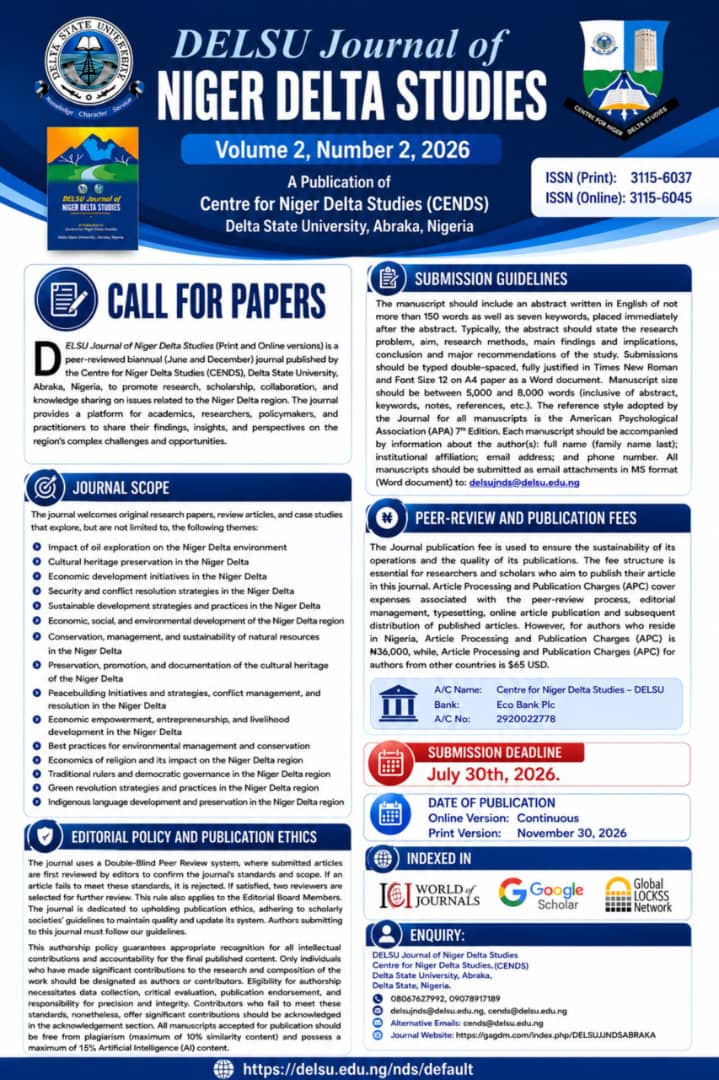
The DELSU Journal of Niger Delta Studies (DELSU-JNDS) is a bi-annual (June and December) peer-reviewed journal published by the Centre for Niger Delta Studies (CENDS), Delta State University, Abraka, Nigeria. This statement outlines the ethical responsibilities of all parties involved in the publication of an article in this journal, such as the author, the peer-reviewer, the chief editor (editor-in-chief), associate editors, review editors and the publisher. (Much of this statement is taken from COPE’s Best Practice Guidelines for Journal Editors).
AUTHOR'S RESPONSIBILITY
Reporting Standards
Authors of original research are expected to provide an accurate account of the work performed and an objective discussion of its significance. The data of the research should be rightly organized in the article. It is unethical and unacceptable to make fraudulent or knowingly false statements.
Data Access and Retention
The raw data may be requested from the authors in connection with an article for editorial review and the authors should be prepared to provide public access to such data, if practicable, and should in any event be prepared to retain such data for a reasonable time after publication.
Plagiarism and Originality
Authors must ensure that the work they submit is their own original work and that where the work and/or words of others have been used by the authors, these have been properly cited or quoted. The quotations and citations in this article must be included in the reference at the end of the article.
Multiple Publication
In general, an author should not publish in more than one journal or primary publication, in part or in whole, manuscripts describing essentially the same research. Publishing the same article in more than one journal is considered unethical publishing behaviour.
Sources Cited
Credit for the work of others must be given at all times. Authors should cite publications which have made a significant contribution to the identification of the nature of the work.
Paper Authorship
Authorship should be based on substantial contributions to the conception and design, or the acquisition of data, or the analysis and interpretation of data. They should be recognized or named as contributors. Others who have been involved in some substantive aspects of the research project.
Corresponding Author
The corresponding author is the author who corresponds with the journal about the publication. The corresponding author is responsible for ensuring the article includes all appropriate co-authors and no inappropriate co-authors. All authors have read and approved the manuscript and agreed to submit it to the journal.
Funding Sources
Recognized Sources of funding for the research reported in the article should be acknowledged at the end of the article.
Disclosures and Conflicts of Interest
All authors must disclose any financial or other substantive conflict of interest that could be perceived as influencing the results or interpretation of their manuscript.
Simple Errors
If an author finds a major error or inaccuracy in his or her own published work, it is the author’s obligation to immediately inform the journal editor or publisher and to assist the editor in retracting or correcting the article.
Correction and Retraction (Post publication discussions)
Letters to the editor-in-chief are reserved for comments that incite discussion or express concerns regarding the published content after post-publication discussions and corrections by COPE. DELSU-JNDS encourages objective, evidence-based comments pertinent to the scholarly discourse and discourages subjective opinion and abusive language. If post-publication discussions indicate a need for correction or retraction of the published content, concerns will be addressed with a Correction or
Retraction Notice
The journal editors are always pleased to see the publication of corrections, clarifications, retractions and apologies where necessary.
RESPONSIBILITIES OF REVIEWERS
Peer Review
The Role Peer review supports the chief editor (editor-in-chief), associate editors, review editors and the editorial board in their editorial decision-making process. Also, peer review helps the author to enhance the quality of the manuscript.
Ability or Timeliness Review
Any reviewer who feels unqualified to review the assigned manuscript or unable to provide a prompt review should notify the chief editor and withdraw from the review process.
Privacy and Cookies
Manuscripts submitted for review are to be considered confidential documents. The chief editor shall not be disclosed to or discussed with any person unless authorized by him.
Reviewers' Generative AI Policy
Critical thinking and independent judgment are essential to the peer review process, and peer reviewers should not employ AI tools to evaluate articles. Generative AI and AI-assisted tools should not be used to evaluate the scientific content of a manuscript, as they may produce inaccurate, partial, or biased conclusions. Reviewers are responsible and accountable for the content of their evaluation reports.
DUTIES OF THE EDITORS
Publication of Articles
The decision to publish articles submitted to the DELSU-JNDS is the prerogative of the chief editors of the journal. The chief editors will be guided by the policies of the journal's editorial board, subject to such legal requirements as may exist regarding libel, copyright infringement and academic misconduct. The chief editor may consult with other editors or reviewers in making this decision.
Fair Play
Manuscripts will be judged for intellectual merit only.
Privacy/Confidentiality
The chief editor, editors and editorial staff will not disclose any information about a submitted manuscript to anyone other than the corresponding author, reviewers, potential reviewers, other editorial board members and the publisher. All manuscripts submitted will be peer-reviewed by the chief editor on a double-blind basis.
Editor’s Policy on Generative AI
Editors are not allowed to feed the articles they receive into AI software, which could breach privacy and copyright.
Declaration and Conflicts of Interest
Unpublished materials disclosed in a submitted manuscript must not be used in any way by the recipients of this information without the written consent of the author.
RULES FOR DEALING WITH MISCONDUCT
Academic Dishonesty Duplicate publication: Publishing the same work, in whole or in part, without appropriate credit
Forgery: Creating data that is not there or making up results
Falsification: The manipulation of research data or processes or the arbitrary alteration of research results
Plagiarism: The use of the ideas, logic, terminology, data sources and analysis of others without appropriate citation. Plagiarism and other breaches of publication ethics are grave. Authors’ rights are respected and allegations of plagiarism or misuse of articles published in the journal are investigated. Manuscripts submitted are checked by duplication-checking software (specifically, Checker-X, Turnitin). Any articles that are found to contain plagiarized material or third-party copyright material without authorization or adequate acknowledgment or in cases where authorship of the article is contested, the editorial board reserve the right to take action, including but not limited to publishing an erratum or corrigendum, removing the article from the journal, taking up the matter with the head of department or dean of the author’s institution and/or relevant academic bodies or societies, proscription of the author from publication in the journal or proper legal action. All the manuscripts accepted for publication should be free from plagiarism (maximum 10% similarity content).
Artificial Intelligence (AI): The cornerstones of academic publishing are originality, intellectual contribution, and human authorship of research. And so, using AI tools properly is important. Artificial intelligence (AI) tools, e.g., ChatGPT, cannot be included as authors in submitted articles, in line with COPE guidelines. The authors are responsible for the content of their articles including any part of the article that has been generated by an AI tool, and are liable for any inaccuracy or violation of publication ethics. According to the recommendations of EASE, authors who have used AI tools in the preparation of their articles should declare the technologies used and their purpose in the AI declaration section. This requirement does not apply to software such as spell or grammar checkers, or reference management tools. If there are any instances of misuse of the generative AI tools identified after publication, the editors of the journal reserve the right to publish a correction or retract the article. Authors can find guidance on the responsible use of generative AI in research in the EU’s Living Guidelines on the Responsible Use of Generative AI in Research. Inappropriate authorship attribution Not acknowledging a contributor who has not made a legitimate contribution to the contents or research results of the manuscript, or acknowledging a contributor who has not made a legitimate contribution to the manuscript.
Informant: Concerning the actual misconduct and related evidence or informing of the misconduct to the editorial committee: 1. Misconduct can be reported verbally, in writing, by telephone, email, etc. or by other means of communication and will be treated as confidential. Nonetheless, regardless of whether it is made in writing or email, anonymously, according to the case reported, specific details and evidence of the misconduct will be processed. 2. The identity of the whistle-blower shall not be disclosed; Whatever the substance of the allegation of misconduct, the report shall not include the identity of the whistleblower so as to protect the whistleblower.
Examinee: As for the editorial committee and investigation or the examinee of the misconduct, the allegation of misconduct shall not be disclosed before a conclusive judgment is made.
Verification: The editorial board is responsible for verifying the facts of misconduct. 1. The editorial committee shall ensure that the whistleblower and the examinee shall have equal rights and opportunities to express their opinions and appeal. 2. The verification target of misconduct is papers published in the journal in a period of three years and papers under review. 3. The fact of misconduct to be verified during verification, preliminary investigation and main investigation.
Pre-investigation: Within thirty days of receipt of the complaint of suspected misconduct, a pre-investigation shall be conducted. Where the provisional findings and the person examined accept the misconduct, the chief editor may take a decision without going through the whole process of the main investigation.
Primary investigation: On the procedure of the main investigation of facts of misconduct. Committee of Inquiry. 1. The investigation committee shall consist of the editors-in-chief and four (4) other editors selected from the editorial committee. Depending on the research topic, however, other relevant external experts may be appointed. 2. The investigation committee shall hear the informant and the examinee before submitting the results of the main investigation. If the parties have objections, the possibility of appeal will be considered. 3. The investigation committee shall decide with a two thirds majority. 4. Upon the confirmation of the results of the main examination, the examinee and the whistleblower shall be notified of the proceedings.
Next Steps Procedurally on a finding of misconduct: 1. The culprit shall be barred from contributing to the journal for a period of three years from the date of final judgment. 2. The manuscript in question will be removed from the website of the journal. The chief editor shall take the measures to delete it from the electronic database. 3. The judgment shall be published on the website of the journal and in the next issue of the journal. Participants’ Consent In the materials and methods section authors conducting research on human subjects should state: a) patients’ consent b) authors specify if the procedures followed have been approved by a responsible review committee. If there is no formal committee, the research must follow the 2013 revised Helsinki Declaration. Where animals are included in the research all animals should have been provided humane care according to the criteria outlined in the Guide for the Care and Use of Laboratory Animals prepared by the National Academy of Science and published by the National Institutes of Health (NIH publication 23-86, revised 1985).
ARCHIVAL POLICY AND REPOSITORY
Authors may self archive in institutional/disciplinary repositories and/or on personal websites. For pre-print versions posted on-line, a citation and link to the final published version in this Journal should be provided when the issue is available. For post-print versions (including the final publisher’s PDF) please add a citation and link to the journal’s website.