Authors’ Guidelines
Prior to submitting manuscript, authors should make sure that they have carefully read and adhere to all the following guidelines and instructions to authors.
Covering letter
To every submission attach a covering a letter approving that all authors have agreed to the submission. The letter should be written and signed by the corresponding author on behalf of all authors. It should also confirm that the manuscript has not been previously published nor is being considered for publication elsewhere. It also should include authors completed contact information such as addresses, telephone and fax numbers, and e-mail.
Submission template
The author is asked to take into account the following order when submitting manuscript:
Theoretical review or theoretical research usually provides a comprehensive and critical analysis of the existing research literature on a particular topic. The content of these papers may vary according to the requirements of the field and the journal, but in general, theoretical review, basic research, or theoretical research includes the following elements:
- File format: Microsoft Word file format is only acceptable for the main manuscript document. All text in manuscripts should be in 12-point Times New Roman font, 1.5 spaced, justified-alignment only.
- Pictures/ Images: Only JPEG (JPG) file format for illustrations and figures is accepted.
- Manuscript length: Each full-length research manuscript should between 5000 and 8000 words. The word count should include the abstract, references, tables, and appendices.
- Sections and subsections: Each manuscript should be divided into a clearly defined section.
- 5. Article structure: Each submitted manuscript should be prepared within the following framework.
- Abstract: The maximum length for an abstract is 250 words. Suggested contents: background and/ state the research problem, aim, research methods, main findings and implications, conclusion and major recommendations of the study. The abstract is often presented separately from the article, so it must be able to stand alone.
- Keywords: Present 7–9 Keywords immediately after abstract.
- Introduction: The introduction should clearly justify the rationale of the study with appropriate theoretical and empirical backgrounds. This section should include the reference of existing literature, credible information and data, and any theoretical support for describing why the current study is a worthy literary work. The introduction should briefly present key findings, contributions, and structure of the rest of the paper. If a separate literature review section is required then, it can be placed immediately after the introduction to develop the hypothesis.
- Literature Review: This section should review related extant literature to identify research gaps.
- Data and Methodology: This section should explain the data source (if any) and the empirical methodologies used in the manuscript. Proper reference should be maintained if the paper is produced by following any published methods.
- Results and Discussion: The result section should present the appropriate empirical results and make extensive discussions on the overall and critical findings. Relevant literature should be cited to reinforce the findings of the study.
- Conclusion and Policy Implications: The Journal holds that every single article published must contain some specific policy implication for policy planner of the appropriate regions or country under study. If the paper is of theoretical nature, the idea of such paper is even more valuable. The conclusion should clearly state the major findings of the paper without much repetition.
Declaration of conflicting interests
Authors’ statements should be placed at the end of their manuscript, after acknowledgements and before the references. This part should have a heading: ‘Statement of Conflicting Interests. If there is no statement, in the article under this heading will be printed ‘None Stated’. Conversely, you may prefer to express that: “The Author(s) state(s) that there is no conflict of interest.”
Acknowledgements
Authors should include their acknowledgements at the end of your article, before the Statement of Conflicting Interests (if there are any). It should also precede their notes and References. The ‘Acknowledgements’ section should include a list of any contributors who lack necessary conditions for authorship. For example, author may acknowledge those who only provided technical help, those who assisted them in writing, or any authority who helped them merely through general support.
Funding acknowledgement
All authors are asked to report their funding/sponsorship on a regular basis and under a separate heading. They need to affirm that: “this research received no specific grant from any funding agency in the public, commercial, or not-for-profit sectors.”
Manuscript house style
Submissions should be prepared according to the manual of the American Psychological Association (APA), 7th Edition. References should be cited in the text by giving the name of the authors(s), the year of publication (in parenthesis), and the page number(s) as follows:
- In the text of a research paper, if the author’s name is part of the narrative, include only the year of publication in the parentheses. Example: According to Sango (2022), teaching art in a poor country is a challenging task because of lack of materials.
- If the author is citing a particular page or chapter of a document, include that information in the parentheses. For example: Teaching art in a poor country is a challenging task because of lack of materials (Sango, 2013, p. 199).
- In general, a scholar is expected to look for and use the original source of the information. When such work becomes difficult to find, a secondary source may be cited as follows: Seidenberg and McClelland’s study (as cited in Coltheart, Curtis, Atkins, & Haller, 1993)
- At the end of the paper, in a section called “References,” full citations are listed in alphabetical order. For example:
- Books by a single author: Kimmel, M. S. (2007). The gendered society. Oxford University Press
- Books by two or more authors: DiFonzo, N., & Bordia, P. (2007). Rumour psychology: Social and organizational approaches. American Psychological Association.
- Books by a Corporate (Group) Author: American Sociological Association. (1975). Approaches to the study of social structure. Free Press.
- Edited Book: Rhodewalt, F. (Ed.). (2008). Personality and social behaviour. Psychology Press
- Book/Document with No Author: The universal declaration of human rights. (1974). U.S. Catholic Conference, Division of Latin America.
- eBooks: Gillam, T. (2018). Creativity, wellbeing and mental health practice. Wiley Blackwell.
- From a website: Sanger, M. (2000). Woman and the new race. Bartleby.com. http://www.bartleby.com/1013/ (Original work published 1920).
- Chapters in Books: Levi-Strauss, C. (1971). Totem and caste. In F. E. Katz (Ed.), Contemporary sociological theory (pp. 82-89). Random House.
- Article, entry, or chapter from an online reference book (encyclopedia, dictionary, handbook): Watkins, M. (2013). Mind-body problem. In H. Pashler (Ed.), Encyclopedia of the mind.
- Journal Article: Klimonske, R., & Palmer, S. (1993). The ADA and the hiring process in organizations. Consulting Psychology Journal: Practice and Research, 45(2), 10-36.
- Newspaper Article – Online: Cieply, M. (2013, November 11). Gun violence in American movies is rising, study finds. New York Times.
- Newspaper Article – Print: Jones, S. (1997, October 19). Hit-and-run suspect commits suicide. New York Times, p. 17.
- Dissertations or Theses: Rockey, R. (2008). An observational study of pre-service teachers’ classroom management strategies [Doctoral dissertation, Indiana University of Pennsylvania].
All citations must be fully listed in the references section at the end of the article in an alphabetical order.
Manuscript formatting and submission
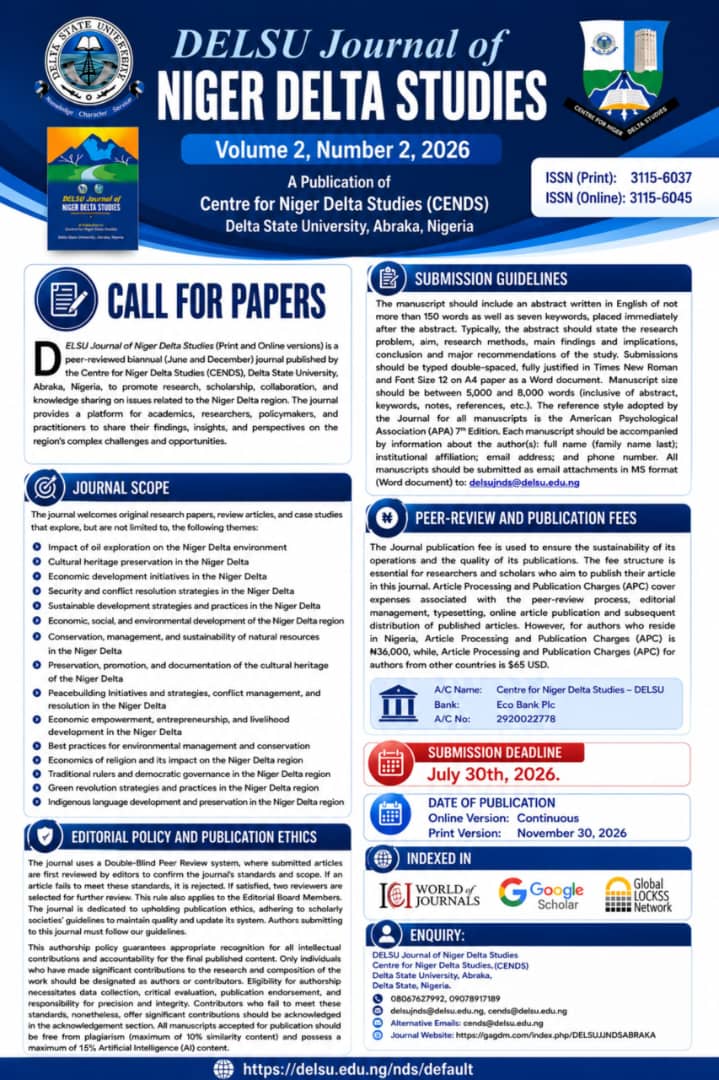
The manuscript should include an abstract written in English of not more than 250 words as well as between seven and nine keywords, placed immediately after the abstract. Typically, the abstract should state the research problem, aim, research methods, main findings and implications, conclusion and major recommendations of the study. Submissions should be typed double-spaced, fully justified in Times New Roman and Font Size 12 on A4 paper as a Word document. Manuscript size should be between 5,000 and 8,000 words (inclusive of abstract, keywords, notes, references, etc.). Each manuscript should be accompanied by information about the author(s): full name (family name last); institutional affiliation; email address; ORCID; and phone number. All manuscripts should be submitted as email attachments in MS format (Word document) to: delsujnds@delsu.edu.ng