About the Journal
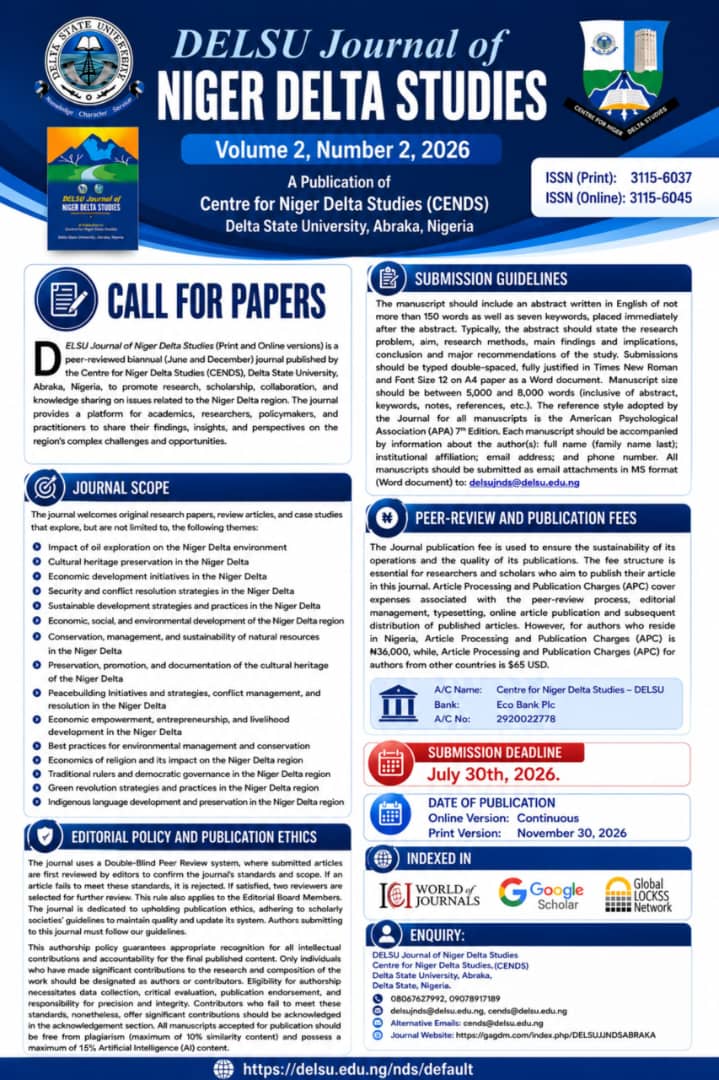
DELSU Journal of Niger Delta Studies (DELSU-JNDS) (Print and Online versions) established 2025, is a peer-reviewed biannual (June and December) journal published by the Centre for Niger Delta Studies (CENDS), Delta State University, Abraka, Nigeria.
Title of Journal: DELSU Journal of Niger Delta Studies
Publishers: Centre for Niger Delta Studies (CENDS), Delta State University, Abraka
Founding Date: 2025
Place of Publication: Abraka, Nigeria
Journal Type: Multi-Disciplinary
Frequency: Biannual (June and December)
Versions: Print and Online
ISSN: 3115-6037 (Print), 3115-6045 (Online)
Website: https://gagdm.com/index.php/DELSUJNDSABRAKA/
Indexed and abstracted in: AJOL; DOAJ; Copernicus; Google Scholar, RJRIndex, IOI World of Journal, and Global Lockss Network (others ongoing)
Publication Language: English
Aims and Scope
Aims:
- To promote research, scholarship, collaboration, and knowledge sharing on issues related to the Niger Delta region.
- Provide a platform for academics, researchers, policymakers, and practitioners to share their findings, insights, and perspectives on the region's complex challenges and opportunities.
- To promote inter-disciplinary research in all areas of academic disciplines.
- To provide a forum for genuine and constructive dialogues between scholars in different fields of scholarship.
Scope:
The journal welcomes original research papers, review articles, and case studies that explore, but are not limited to, the following themes:
- Impact of oil exploration on the Niger Delta environment
- Cultural heritage preservation in the Niger Delta
- Economic development initiatives in the Niger Delta
- Security and conflict resolution strategies in the Niger Delta
- Sustainable development Strategies and practices in the Niger Delta
- Economic, social, and environmental development of the Niger Delta region
- Conservation, management, and sustainability of natural resources in the Niger Delta
- Preservation, promotion, and documentation of the cultural heritage of the Niger Delta
- Peacebuilding Initiatives and strategies, conflict management, and resolution in the Niger Delta
- Economic empowerment, entrepreneurship, and livelihood development in the Niger Delta
- Best practices for environmental management and conservation
- Economy of religion and its impact on the Niger Delta region
- Traditional rulers and democratic governance in the Niger Delta region
- Green revolution strategies and practices in the Niger Delta region
- Indigenous language development and preservation in the Niger Delta region
Editorial and Peer Review Processes
The review process for the DELSU Journal of Niger Delta Studies is double-blinded, meaning neither the reviewer knows the author's identity nor does the author know the reviewers. Submitted articles are first reviewed by editors to confirm the journal's standards and scope. If an article fails to meet these standards, it is rejected. If satisfied, two reviewers are selected for further review. This rule also applies to the Editorial Board Members. Each manuscript is reviewed by at least two referees. Manuscripts are assessed for both structure and relevance to the principles of the DELSU Journal of Niger Delta Studies. They are then reviewed anonymously by two experts in the field (who are not part of the editorial team), selected by the Board according to their areas of expertise. The final decision on manuscript acceptance is made by the Editorial Board through the Chief Editor. The review process is done as quickly as possible, and an editorial decision is normally made within six and eight weeks of submission.
Responsibilities of Editorial Board Members and Reviewers
Editorial board members:
- Chief Editor. Is the CEO of the journal.
- Associate Editor (Publishing Ethics). In charge of checking and maintaining the ethical standard of the journal and manuscripts accepted for publication.
- Associate Editor (Article Review). Assigns checked submitted manuscripts to peer reviewers and collate reviewers’ reports for further processing.
- Associate Editor (Book Review). In charge of book review to be published in the journal.
- Managing Editor. In charge of administration, circulation, APC, etc.
- Editorial Assistant/Secretary. Serves as a general assistant to the editors. He is also in charge of the journal secretariat.
Reviewers:
- Supporting the Chief Editor in making decisions and helping authors to enhance their manuscripts through editorial feedback.
- Refusing to review papers if they lack the necessary expertise or cannot review them in a timely manner.
- Keeping manuscripts confidential and not sharing them without authorization.
- Providing impartial critiques without personal bias, offering constructive, evidence-backed comments.
- Pointing out significant works that have not been cited and alerting about possible plagiarism or duplication with other works.
- Ensuring confidentiality of all information and ideas gained during the review process and avoiding reviewing any manuscripts where there is a conflict of interest.
OPEN ACCESS POLICY
The DELSU Journal of Niger Delta Studies is published under Open Access and dedicated to the unrestricted publication of academic research and is a fully open-access publication. A copy of the Creative Commons Attribution–NonCommercial 4.0 International License (CC BY-NC-SA 4.0), which governs the distribution of all articles published in the Journal, can be found at: https://creativecommons.org/licenses/by-nc-sa/4.0/
Under users who abide by the terms and conditions outlined in the CC BY-NC-SA 4.0 license are granted the following rights:
- Copy and distribute the content in any format or media.
- Adapt the content by remixing, changing, and expanding upon it.
- As long as users abide by the license terms, the Journal, the licensor, cannot take away these liberties.
All uses of the published work are subject to the following restrictions:
Attribution: Users are required to link to the license, give due credit to the original author or authors, and specify whether any changes were made. Users are free to do so in any way that makes sense, but not in a way that implies the licensor approves of the user or their use of the work.
NonCommercial: No commercial use of the content is permitted. For the avoidance of doubt, "commercial purposes" refers to any use that is primarily intended for or directed toward monetary compensation or commercial advantage. This includes, but is not limited to, reselling the work, incorporating it into a product or service that is offered for sale, or using it in paid advertising or promotional materials.
No further limitations: Users are not allowed to implement legal clauses or technological restrictions that prohibit others from doing anything that the license permits.
Liability and warranty: There are no guarantees or warranties included in the licence. The work is supplied "as is," and neither the Journal nor the author or authors make any claims about it, including but not limited to warranties of title, merchantability, fitness for a specific purpose, non-infringement, or the lack of latent or other defects.
Third-party material: The author or authors are responsible for obtaining any necessary permissions from the relevant rights holders when the article contains third-party material (such as illustrations, photographs, or lengthy quotations). Unless otherwise specified, the Journal's CC BY-NC-SA 4.0 license does not automatically apply to such third-party content.
Moral rights: Nothing in this license is meant to diminish, restrict, or revoke any author's moral rights, such as the right to be identified as the author of the work and the right to object to its disparaging treatment. Please see the complete legal text of the CC BY-NC-SA 4.0 license:
https://creativecommons.org/licenses/by-nc-sa/4.0/legalcode.en
Copyright, Licensing Terms, and Permissions
Under open access license, authors retain ownership of the copyright for their content, but allow anyone to download, reuse, and reprint, modify, distribute, and/or copy the content as long as the original authors and source are cited properly.
The views expressed in published articles are those of the author(s) and do not necessarily reflect the official policy or position of Delta State University, Abraka, or the Editorial Board of the DELSU Journal of Niger Delta Studies.
Authors grant the DELSU Journal of Niger Delta Studies the following non-exclusive rights to:
- publish, reproduce, distribute, display, and store the contribution in print and electronic formats;
- include the contribution in collections, create summaries, extracts, and abstracts;
- create adaptations and derivative works for the purpose of dissemination; and
- license third parties to do any or all of the above
Author Charges
The journal publication fee is used to ensure the sustainability of its operations and the quality of its publications. The fee structure is essential for researchers and scholars who aim to publish their article in this journal. Article Processing Charges (APC) cover expenses associated with the peer-review process, editorial management, typesetting, online article publication and subsequent distribution of published articles. However, for authors who reside in Nigeria, Article Processing and Publication Charges (APC) is ₦36,000, while, Article Processing and Publication Charges (APC) for authors from other countries is $70 USD.
Publishing Ethics and Policies
Participants’ consent:
Authors who study on human subjects need to state that in the materials and methods section: a) patients’ consent and b) authors specify whether the procedures followed have been gauged by a responsible review committee. Where no formal committee is available the research must be in accordance with Helsinki Declaration as revised in 2013. Where animals are included in the research all animals should have received human care according to the criteria outlined in the Guide for the Care and Use of Laboratory Animals prepared by the National Academy of Science and published by the National Institutes of Health (NIH publication 23-86, revised 1985).
Plagiarism and artificial intelligence (AI):
Plagiarism or other breaches in publication are taken extremely seriously. The rights of authors are protected and claims of plagiarism or misuse of articles published in the journal are investigated. Manuscripts submitted are checked using duplication-checking software (specifically, Checker-X, Turnitin). If a manuscript is found to have plagiarized other work or contained third-party copyright material without authorization or adequate acknowledgement, or where authorship of the article is contested, the Board reserves the right to take action including, but not limited to: publishing an erratum or corrigendum; removing the article from the journal; taking up the matter with the head of department or dean of the author’s institution and/or relevant academic bodies or societies; proscription of the author from publication in the journal or proper legal action. All manuscripts accepted for publication should be free from plagiarism (maximum of 10% similarity content) and possess a maximum of 15% Artificial Intelligence (AI) content. The journal is dedicated to upholding publication ethics, adhering to scholarly societies' guidelines to maintain quality and update its system. Authors submitting to this journal must follow our guidelines.
Repository and archiving policies
Authors are permitted to post their work online in institutional/disciplinary repositories or on their own websites. Pre-print versions posted online should include a citation and link to the final published version in this Journal as soon as the issue is available; post-print versions (including the final publisher's PDF) should include a citation and link to the journal's website.
Authors’ Guidelines
Prior to submitting manuscript, authors should make sure that they have carefully read and adhere to all the following guidelines and instructions to authors.
Covering letter
To every submission attach a covering a letter approving that all authors have agreed to the submission. The letter should be written and signed by the corresponding author on behalf of all authors. It should also confirm that the manuscript has not been previously published nor is being considered for publication elsewhere. It also should include authors completed contact information such as addresses, telephone and fax numbers, and e-mail.
Submission template
The author is asked to take into account the following order when submitting manuscript:
Theoretical review or theoretical research usually provides a comprehensive and critical analysis of the existing research literature on a particular topic. The content of these papers may vary according to the requirements of the field and the journal, but in general, theoretical review, basic research, or theoretical research includes the following elements:
- File format: Microsoft Word file format is only acceptable for the main manuscript document. All text in manuscripts should be in 12-point Times New Roman font, 1.5 spaced, justified-alignment only.
- Pictures/ Images: Only JPEG (JPG) file format for illustrations and figures is accepted.
- Manuscript length: Each full-length research manuscript should between 5000 and 8000 words. The word count should include the abstract, references, tables, and appendices.
- Sections and subsections: Each manuscript should be divided into a clearly defined section.
- 5. Article structure: Each submitted manuscript should be prepared within the following framework.
- Abstract: The maximum length for an abstract is 250 words. Suggested contents: background and/ state the research problem, aim, research methods, main findings and implications, conclusion and major recommendations of the study. The abstract is often presented separately from the article, so it must be able to stand alone.
- Keywords: Present 7–9 Keywords immediately after abstract.
- Introduction: The introduction should clearly justify the rationale of the study with appropriate theoretical and empirical backgrounds. This section should include the reference of existing literature, credible information and data, and any theoretical support for describing why the current study is a worthy literary work. The introduction should briefly present key findings, contributions, and structure of the rest of the paper. If a separate literature review section is required then, it can be placed immediately after the introduction to develop the hypothesis.
- Literature Review: This section should review related extant literature to identify research gaps.
- Data and Methodology: This section should explain the data source (if any) and the empirical methodologies used in the manuscript. Proper reference should be maintained if the paper is produced by following any published methods.
- Results and Discussion: The result section should present the appropriate empirical results and make extensive discussions on the overall and critical findings. Relevant literature should be cited to reinforce the findings of the study.
- Conclusion and Policy Implications: The Journal holds that every single article published must contain some specific policy implication for policy planner of the appropriate regions or country under study. If the paper is of theoretical nature, the idea of such paper is even more valuable. The conclusion should clearly state the major findings of the paper without much repetition.
Declaration of conflicting interests
Authors’ statements should be placed at the end of their manuscript, after acknowledgements and before the references. This part should have a heading: ‘Statement of Conflicting Interests. If there is no statement, in the article under this heading will be printed ‘None Stated’. Conversely, you may prefer to express that: “The Author(s) state(s) that there is no conflict of interest.”
Acknowledgements
Authors should include their acknowledgements at the end of your article, before the Statement of Conflicting Interests (if there are any). It should also precede their notes and References. The ‘Acknowledgements’ section should include a list of any contributors who lack necessary conditions for authorship. For example, author may acknowledge those who only provided technical help, those who assisted them in writing, or any authority who helped them merely through general support.
Funding acknowledgement
All authors are asked to report their funding/sponsorship on a regular basis and under a separate heading. They need to affirm that: “this research received no specific grant from any funding agency in the public, commercial, or not-for-profit sectors.”
Manuscript house style
Submissions should be prepared according to the manual of the American Psychological Association (APA), 7th Edition. References should be cited in the text by giving the name of the authors(s), the year of publication (in parenthesis), and the page number(s) as follows:
- In the text of a research paper, if the author’s name is part of the narrative, include only the year of publication in the parentheses. Example: According to Sango (2022), teaching art in a poor country is a challenging task because of lack of materials.
- If the author is citing a particular page or chapter of a document, include that information in the parentheses. For example: Teaching art in a poor country is a challenging task because of lack of materials (Sango, 2013, p. 199).
- In general, a scholar is expected to look for and use the original source of the information. When such work becomes difficult to find, a secondary source may be cited as follows: Seidenberg and McClelland’s study (as cited in Coltheart, Curtis, Atkins, & Haller, 1993)
- At the end of the paper, in a section called “References,” full citations are listed in alphabetical order. For example:
- Books by a single author: Kimmel, M. S. (2007). The gendered society. Oxford University Press
- Books by two or more authors: DiFonzo, N., & Bordia, P. (2007). Rumour psychology: Social and organizational approaches. American Psychological Association.
- Books by a Corporate (Group) Author: American Sociological Association. (1975). Approaches to the study of social structure. Free Press.
- Edited Book: Rhodewalt, F. (Ed.). (2008). Personality and social behaviour. Psychology Press
- Book/Document with No Author: The universal declaration of human rights. (1974). U.S. Catholic Conference, Division of Latin America.
- eBooks: Gillam, T. (2018). Creativity, wellbeing and mental health practice. Wiley Blackwell.
- From a website: Sanger, M. (2000). Woman and the new race. Bartleby.com. http://www.bartleby.com/1013/(Original work published 1920).
- Chapters in Books: Levi-Strauss, C. (1971). Totem and caste. In F. E. Katz (Ed.), Contemporary sociological theory(pp. 82-89). Random House.
- Article, entry, or chapter from an online reference book (encyclopedia, dictionary, handbook): Watkins, M. (2013). Mind-body problem. In H. Pashler (Ed.), Encyclopedia of the mind.
- Journal Article: Klimonske, R., & Palmer, S. (1993). The ADA and the hiring process in organizations. Consulting Psychology Journal: Practice and Research, 45(2), 10-36.
- Newspaper Article – Online: Cieply, M. (2013, November 11). Gun violence in American movies is rising, study finds. New York Times.
- Newspaper Article – Print: Jones, S. (1997, October 19). Hit-and-run suspect commits suicide. New York Times, p. 17.
- Dissertations or Theses: Rockey, R. (2008). An observational study of pre-service teachers’ classroom management strategies [Doctoral dissertation, Indiana University of Pennsylvania].
All citations must be fully listed in the references section at the end of the article in an alphabetical order.
Manuscript formatting and submission
The manuscript should include an abstract written in English of not more than 250 words as well as between seven and nine keywords, placed immediately after the abstract. Typically, the abstract should state the research problem, aim, research methods, main findings and implications, conclusion and major recommendations of the study. Submissions should be typed double-spaced, fully justified in Times New Roman and Font Size 12 on A4 paper as a Word document. Manuscript size should be between 5,000 and 8,000 words (inclusive of abstract, keywords, notes, references, etc.). Each manuscript should be accompanied by information about the author(s): full name (family name last); institutional affiliation; email address; ORCID; and phone number. All manuscripts should be submitted as email attachments in MS format (Word document) to: delsujnds@delsu.edu.ng
Special Issues
DELSU Journal of Niger Delta Studies publishes Special Issues to create collections of papers on specific topics, with the aim of building a community of authors and readers to discuss the latest research and develop new ideas and research directions. Special Issues are led by Guest Editors, who are experts on the topic and all Special Issue submissions follow DELSU-JNDS guidelines and standard. The journal’s Chief Editor and/or designated Editorial Board Member will oversee Guest Editor appointments and Special Issue proposals, checking their content for relevance and ensuring the suitability of the material for the journal. The papers published in a Special Issue will be collected and displayed on a dedicated page of the journal’s website. Further information on DELSU-JNDS’ Special Issue policies:
- The Chief Editor is responsible for the content of the entire journal, including all special issues, which must fall within the scope of the journal
- Special issue articles must have the same editorial oversight as regular papers, including external peer review, and be clearly labelled
- Journals must ensure that guest editors’ credentials are checked and approved
- The Chief Editor or dedicated board members must oversee the guest editors
- Papers submitted to a special issue by the guest editor(s) must be handled under an independent review process and make up no more than 25% of the issue's total
Book Review
Book Reviews (750-1,200 words) include critiques of books and book length reports from international organizations. Include a JPG (600 dpi) of a cover image of the reviewed item. Review a list of selected book titles then contact our Book Review Editor to express interest in reviewing one of the book titles listed or to suggest other books for a proposed review. Book reviews must be submitted via email to the Book Review Editor.
Indexed and abstracted in:
AJOL; DOAJ; Copernicus; Google Scholar, RJRIndex, IOI World of Journal, and Global Lockss Network (others ongoing). The Journal has also started the process of indexing her published articles in other world indexing bodies including Web of Science, SCOPUS, and EBSCO.

JOURNAL CONTACTS
DELSU Journal of Niger Delta Studies
Centre for Niger Delta Studies (CENDS),
Delta State University, Campus 2, PMB 0001,
Abraka, Delta State, Nigeria
Phone: +2348067627992; +2349078917189
Email: delsujnds@delsu.edu.ng
Journal Website
Current Issue
Articles
-
STRATEGIC MEDIA ADVOCACY, ENVIRONMENTAL LAW, AND SUSTAINABLE AGRICULTURE IN NIGERIA’S RURAL NIGER DELTA
Abstract views: 39 PDF downloads: 63 -
PETRO-VIOLENCE AND THE FEMALE BODY: GENDERED ECOLOGIES OF RESISTANCE IN CONTEMPORARY NIGER DELTA FICTION
Abstract views: 43 PDF downloads: 31 -
MUSIC PRODUCTION AS A TOOL FOR INDIGENOUS LANGUAGE DEVELOPMENT IN THE NIGER DELTA REGION
Abstract views: 38 PDF downloads: 36 -
SOCIO-RELIGIOUS DYNAMICS AND CULTURAL HERITAGE PRESERVATION IN THE NIGER DELTA: CHALLENGES, OPPORTUNITIES, AND SUSTAINABLE DEVELOPMENT
Abstract views: 41 PDF downloads: 31 -
OIL, MIGRATION, RELIGION, AND MARITAL ALLIANCES: INTERMARRIAGE AS A STRATEGY FOR SOCIAL CAPITAL IN THE NIGER DELTA
Abstract views: 33 PDF downloads: 40 -
MOTHERS’ ATTITUDES TOWARD CHILDHOOD IMMUNIZATION AGAINST VACCINE-PREVENTABLE DISEASES AMONG MOTHERS IN BAUCHI STATE, NIGERIA
Abstract views: 29 PDF downloads: 26 -
AN EVALUATION OF GOVERNMENT POLICY INTERVENTION FOR OVERCOMING BARRIERS TO NATION-BUILDING IN AFRICA, 1960-2025
Abstract views: 31 PDF downloads: 27 -
WHEN BEAUTY BECOMES DANGEROUS: CERAMIC TILES, DOMESTIC SAFETY, AND AESTHETIC PREFERENCES IN MODERN HOMES IN ABRAKA,DELTA STATE
Abstract views: 93 PDF downloads: 53 -
RELIGIOUS EVALUATION OF THE IMPACT OF OIL EXPLORATION ON NIGER DELTA DEVELOPMENT: AN ECO-THEOLOGICAL ANALYSIS
Abstract views: 39 PDF downloads: 34 -
STEWARDS AND NOT OWNERS: HUMAN RESPONSIBILITY TO CARE FOR THE ENVIRONMENT IN GENESIS 1:28-31
Abstract views: 42 PDF downloads: 34 -
EXAMINATION OF CHRISTIANS’ ATTITUDES TOWARDS POLITICAL LEADERSHIP IN SAPELE LOCAL GOVERNMENT AREA OF DELTA STATE
Abstract views: 39 PDF downloads: 37 -
EXTENDED FAMILY IN URHOBO SOCIETY: A CULTURAL NEXUS OF SOLIDARITY AND IDENTITYOF THE NIGER DELTA
Abstract views: 60 PDF downloads: 31 -
ETHICAL ISSUES IN THE USE OF ARTIFICIAL INTELLIGENCE (AI) IN BIBLICAL HERMENEUTICS
Abstract views: 39 PDF downloads: 31 -
THE RELEVANCE OF POPE FRANCIS’ PERSPECTIVES ON THE CATHOLICUS CHORUS FOR THE PERFORMANCE OF MUSIC BY CATHOLIC CHURCHES IN NIGERIA
Abstract views: 19 PDF downloads: 10 -
URHOBO REDUPLICATION AND ITS PHONOLOGICAL MANIFESTATIONS
Abstract views: 33 PDF downloads: 13 -
EVALUATION OF MUSIC TEACHING METHODS AND CURRICULUM ALIGNMENT IN JUNIOR SECONDARY SCHOOLS IN UGHELLI NORTH LOCAL GOVERNMENT AREA, DELTA STATE
Abstract views: 25 PDF downloads: 13 -
TOWARDS A DECOLONIAL FRAMEWORK FOR VISUAL COMMUNICATION DESIGN AND CULTURAL HERITAGE PRESERVATION IN THE NIGER DELTA
Abstract views: 23 PDF downloads: 14