About the Journal
Journal Policy
The Abraka Journal of Religion and Philosophy (AJRP) 2971–5989 (Print) 2971–5997 (Online) is a peer-review scholarly journal. The journal is published by the Department of Religious Studies and Philosophy, Faculty of Arts, Delta State University, Abraka, Nigeria. The Journal is published biannually (July and December) in both print and online versions. AJRP publishes original papers, reviewed papers, conceptual frameworks, analytical and simulation models, case studies, empirical research, technical notes, and book reviews in theology, religious studies and philosophy including other related areas of the Arts, Humanities and Social Sciences.
Article Submission
The manuscript should include an abstract written in English of not more than 250 words as well as five or eight keywords, placed immediately after the abstract. Typically, the abstract should state the research problem, aim, methods, main findings, implications, conclusion and major recommendations of the study. Manuscript should be typed double-spaced, fully justified, in Times New Roman and Font Size 12 on A4 paper as a Word document. The manuscript size should be between 4,000 and 6,000 words (including abstract, keywords, notes, references, etc.). The documentation style adopted by the Journal for all manuscripts is the American Psychological Association (APA) 7th edition OR the Modern Language Association (MLA) 7th edition. Authors should use one style consistently. Each manuscript should be accompanied by information about the author: (1) full name (family name last); (2) institutional affiliation (3) email addresses and phone numbers. Manuscripts should be submitted as e-mail attachments in MS format to: ajrp@delsu.edu.ng and relphiljournal@gmail.com with evidence of the payment of five thousand naira for peer review. Contributors should kindly note that, as a rule. AJRP will not publish multiple articles by the same author in one issue.
The Publication Ethics
The integrity of scholarly publishing is paramount, especially in fields such as religion and philosophy, where the interpretation of ideas and the presentation of research can impact societal beliefs and perspectives. At Abraka Journal of Religion and Philosophy, we recognize this responsibility and strive to uphold the highest ethical standards in our publication processes. Our commitment to publication ethics encompasses several key principles aimed at maintaining transparency, accountability, and scholarly rigor.
(a) Author’s Responsibilities
Authors submitting paper in AJRP must ensure that their work is original, well-researched, and free from plagiarism. We expect authors to provide proper attribution for all sources referenced and to adhere to the academic integrity standards of their respective disciplines. Furthermore, authors are encouraged to disclose any conflicts of interest that might influence their research. By fostering an environment of honesty and transparency, we aim to uphold the trust placed in scholarly research.
(b) Peer Review Process
The peer review process is a cornerstone of academic publishing, and at Abraka Journal, it is conducted with meticulous care. Our reviewers are selected based on their expertise in the relevant fields, and they are tasked with providing constructive feedback that can enhance the quality of the manuscript. The integrity of this process protects the journal’s credibility and the validity of the scholarship it publishes.
(c) Handling Allegations of Misconduct
In the event of suspected research misconduct, such as plagiarism, data fabrication, or unethical practices, Abraka Journal has established protocols for addressing these allegations. We take such matters seriously and will investigate any claims thoroughly, involving relevant stakeholders as necessary. If misconduct is substantiated, the journal reserves the right to retract published articles or take appropriate corrective measures to ensure the integrity of the journal and its content.
(d) Transparency and Accessibility
The Abraka Journal is committed to the principles of transparency and accessibility. We believe in the free exchange of ideas, and therefore, our journal follows an open-access model, making research articles available without financial barriers to readers. This approach not only democratizes access to knowledge but also encourages a broader dialogue within the fields of religion and philosophy.
Article Publication and Processing Fee
One of the essential factors to consider when submitting an article to any journal is the publication fee. The Abraka Journal of Religion and Philosophy imposes an article publication fee to help cover the costs associated with the peer review process, editing, formatting, online article publication and overall maintenance of the journal. While the specific fee may fluctuate, it is crucial for authors to check the journal's official website or guidelines for the most current information. However, article publication fee for single author is ₦30,000, while for more than two authors is ₦40,000. Authors outside Nigeria is $60.
Journal Indexing
In the contemporary academic landscape, the indexation of journals plays a pivotal role in enhancing visibility, accessibility, and overall impact within scholarly communities. The Abraka Journal of Religion and Philosophy articles are indexed in Google Scholar and Copernicus. This marks a critical milestone in the journal's journey, reflecting its commitment to promoting rigorous academic discourse in the fields of religion and philosophy.
The inclusion of The Abraka Journal of Religion and Philosophy in these indexing services offers numerous benefits to authors, researchers, and the broader academic community. First and foremost, it increases the journal's visibility to a global audience, allowing scholars from various parts of the world to access and engage with its content.
Copyrights
Copyrights for articles published in Abraka Journal of Religion and Philosophy (AJRP) are retained by the authors, with first publication rights granted to the journal. The journal/publisher is not responsible for subsequent uses of the work. It is the author's responsibility to bring an infringement action if so desired by the author.
Current Issue
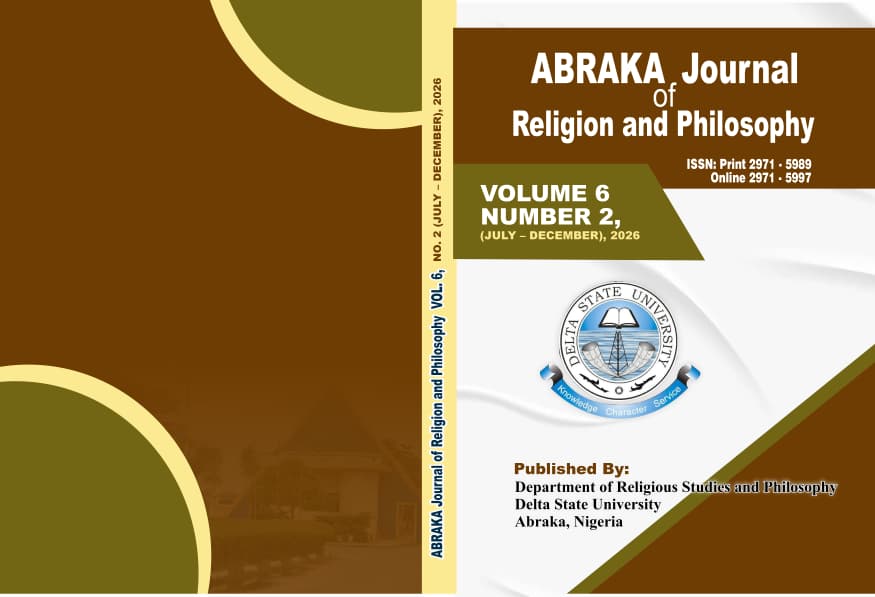
Articles
-
Misuse of the Qur’an in Extremist Ideologies: A Contextual Hermeneutical Response
Abstract views: 16 PDF downloads: 11 -
Exploring Joseph's Leadership Qualities in Genesis41:33–53: Implications for Nigerian Leaders
Abstract views: 25 PDF downloads: 18 -
Covenant in Ancient Israel and Májẹ̀mú in Yoruba Culture: A Comparative Theological Study
Abstract views: 12 PDF downloads: 9 -
Significance and Misconceptions about Burial Rites in Islam and Christianity: A Comparative Analysis
Abstract views: 10 PDF downloads: 9 -
Blood, Sacrifice, and Atonement: Old Testament Sacrificial Rites in African Traditional Ritual Perspective
Abstract views: 20 PDF downloads: 10 -
Rethinking Moral Responsibility and Public Accountability: Religious Ethics and the Crisis of Corruption in Nigeria
Abstract views: 19 PDF downloads: 11 -
From Societas Inaequalis to People of God: Theological and Historical Foundations of the Juridic Rights of the Christian Faithful
Abstract views: 11 PDF downloads: 9 -
Contextual Interpretation of Leviticus 18:22 among People of Asaba, Nigeria
Abstract views: 12 PDF downloads: 11 -
Your Body is the Temple of the Holy Spirit”: 1 Cor6:19–20 and Christian Attitudes toward Healthcare
Abstract views: 11 PDF downloads: 1 -
Reformed Ogboni Fraternity in Yorubaland:Engaging Politics to Maintain Religious Unity
Abstract views: 9 PDF downloads: 3 -
Repentance and Identity Formation in the Ministry of John the Baptist: A Theological and Socio-Historical Study of Matthew 3:1–12
Abstract views: 16 PDF downloads: 8 -
Test Everything: AI-Generated Knowledge and the Loss of Human Discernment in Light of 1Thessalonians 5:21
Abstract views: 10 PDF downloads: 4
